- English (UK)


FX Begins To Move Past Geopolitics As Market Seeks A Fresh Driver

FX Moves Past Geopolitics
It’s not only the equity market, stateside at least, that has recovered all losses seen since the beginning of conflict in the Middle East, but the G10 FX market is also acting as if the events of March never actually happened, with the dollar now back to essentially unchanged levels compared to where we were at the end of February.
_3_2026-04-15_11-20-30.jpg)
In a very similar manner to what we’ve seen in the equity complex, FX participants are focused, for the time being, squarely on the light that we now see at the end of the tunnel. While weekend US-Iran peace talks in Pakistan failed to reach a deal, backchannel communications are continuing between the two sides. Concurrently, President Trump’s Hormuz blockade appears to be working as a negotiating gambit to force concessions out of the Iranians, while the 2-week long ceasefire continues to hold, with neither side seemingly seeking a major re-escalation of hostilities.
Against such a backdrop, participants have been able to price out a degree of ‘left tail’ risk, which in turn has not only seen the dollar’s haven premium eroded, but also triggered a substantial decline in FX volatility. In fact, JPM’s proprietary gauge of G7 FX implied vol now sits at its lowest levels since late-Jan.
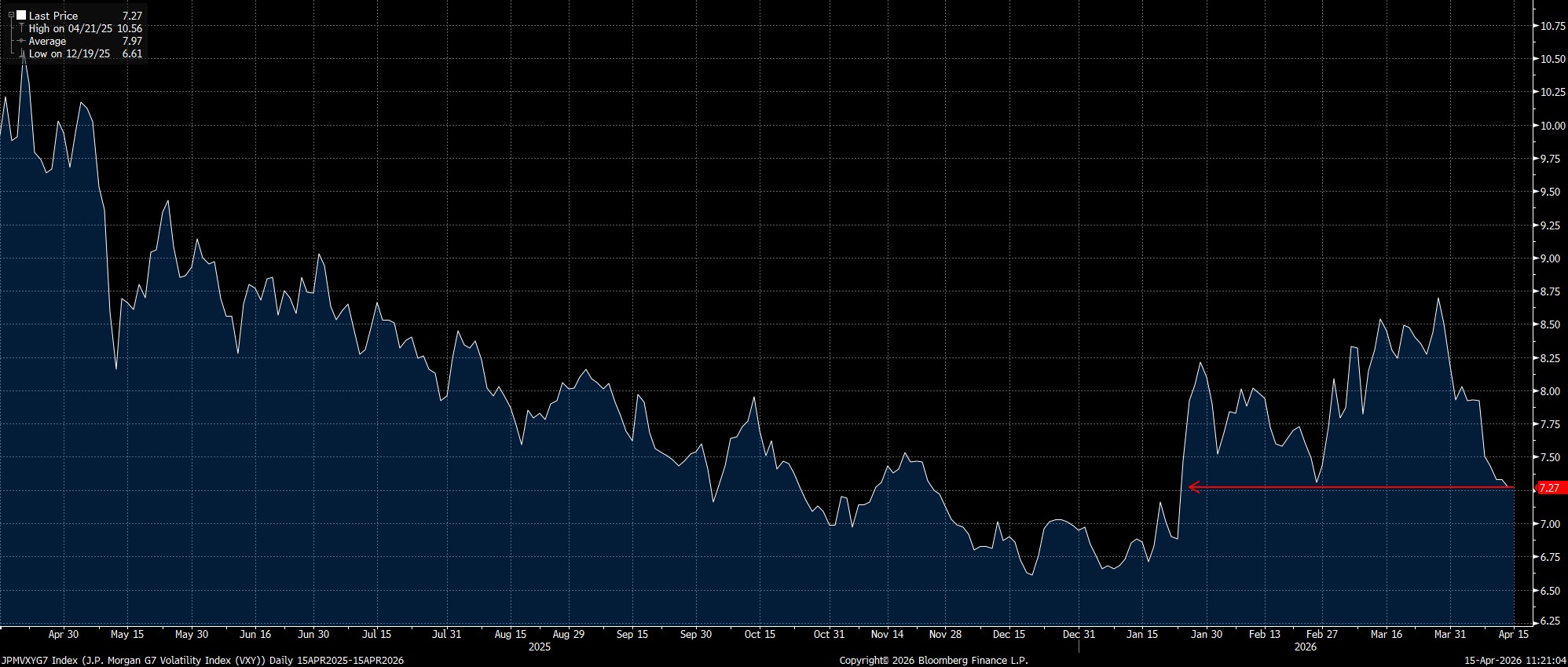
The Market Seeks A New Narrative
With all this in mind, it seems increasingly clear that the FX market is moving away from a dynamic where participants are focused squarely, and solely, on geopolitical events, and towards one where attention is increasing pivoting to the question of ‘what damage has the conflict caused?’.
To be clear, at the time of writing, a formal peace agreement to end the conflict in a durable manner has not yet been agreed, it is simply a case of markets ‘front-running’ what many now see as an inevitable conclusion. It could well be the case that such a deal needs to be signed ‘on the dotted line’ before participants are fully willing and able to move on.
In any case, this potential shift in the underlying market dynamics warrants further deliberation, given that how markets view the answer to that question is likely to hold the key in terms of trading direction over the medium-term.
Divergences Begin To Emerge
At face value, the US economy appears to be in a much better place to weather any economic damage that higher energy prices may trigger. Not only is the US a net energy exporter, but the consumer was also in relatively good health ahead of conflict breaking out. Added to which, the tax refunds that will be paid out this year as a result of the OBBBA are likely to largely compensate for any higher expenditure on energy, further cushioning against any negative impact on consumption more broadly. On top of this, the recovery on Wall Street should allow the ‘wealth effect’ to persist, further propping up consumer spending among higher income bands.
This backdrop contrasts starkly with what we see elsewhere. In the eurozone, for instance, not only is the consumer landscape considerably more pessimistic, but the bloc is also substantially more exposed to higher commodity prices, by virtue of being a significant energy importer. There is also much less fiscal space in Europe, compared to elsewhere in DM, when it comes to potential measures that could be implemented to cushion the impact of the energy price shock.
Similar goes for the UK, where there is not only a litany of well-documented fiscal issues, but also potential political uncertainty on the horizon amid what still seems an inevitable Labour leadership challenge after this May’s local elections. Other G10s aren’t especially attractive either, with the JPY on the ropes amid improving risk appetite, and the Swissie unattractive for similar reasons, while an eventual retracement in crude could pose headwinds for the loonie as well. In many ways, this adds up to a ‘bullish dollar by default’ view.
A Potential Monetary Spanner In The Works
Potentially complicating all this, though, is the monetary backdrop, with swaps continuing to discount tightening from both the ECB and the BoE. While my view remains that a rate hike at this juncture, into what will ultimately prove a negative demand shock, would be a grave policy mistake, this might not stop rate-setters from pulling the trigger, especially in the case of the ECB, who are rather infamous for their uncanny ability to hike at precisely the wrong time – see, July 2008, and July 2011.
This poses an interesting question as to whether the market would cheer policy tightening by bidding up the respective currency due to the higher yield on offer; or, whether the market would react adversely, given that a rate hike would present another, stiffer headwind to economic activity.
Over the medium-term, I’d wager that the latter argument should win out. However, the two-sided risk here does somewhat dent the attraction of GBP, and to a greater extent EUR, shorts at the current juncture, considering the knee-jerk rally that could be seen in the event of a rate hike being delivered. Hence, the risk-reward for buying the dollar dip would start to look more attractive around the 1.20 mark in EUR/USD, or around the Jan highs in cable, compared to where we sit at present.
_Daily_15A_2026-04-15_11-21-23.jpg)
The material provided here has not been prepared in accordance with legal requirements designed to promote the independence of investment research and as such is considered to be a marketing communication. Whilst it is not subject to any prohibition on dealing ahead of the dissemination of investment research we will not seek to take any advantage before providing it to our clients.
Pepperstone doesn’t represent that the material provided here is accurate, current or complete, and therefore shouldn’t be relied upon as such. The information, whether from a third party or not, isn’t to be considered as a recommendation; or an offer to buy or sell; or the solicitation of an offer to buy or sell any security, financial product or instrument; or to participate in any particular trading strategy. It does not take into account readers’ financial situation or investment objectives. We advise any readers of this content to seek their own advice. Without the approval of Pepperstone, reproduction or redistribution of this information isn’t permitted.